“What would I do?”
The role of disaster ruins in preserving things
“as they were”
Ukedo Elementary School: A symbol of the community
Following the lifting of the “Difficult-to-Return” zone designation after six long years, the school was developed as a disaster ruin. It is now open to the public as a facility to encourage people to think about disaster prevention and to pass down lessons to future generations.
While it is a place where one can vividly feel the scars of the disaster, there is much to be learned from Ukedo Elementary School, where not a single life was lost.
I would like to share my thoughts on Ukedo Elementary School as a disaster ruin and its role moving forward.
“There is no single right answer”: Learning from the reality as it is
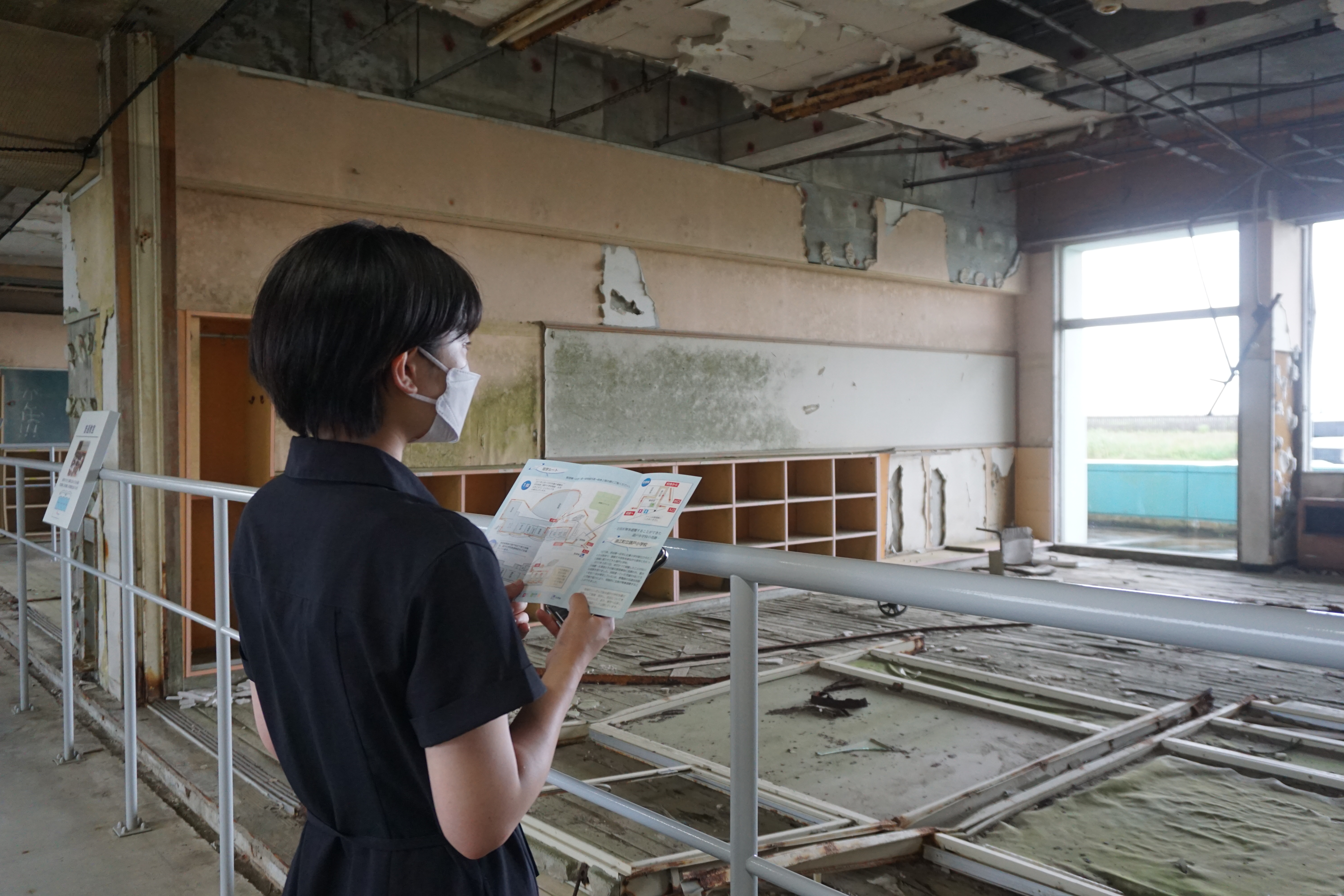
Located in the coastal Ukedo district of Namie Town, Ukedo Elementary School remains exactly as it was when the disaster struck. I believe there is a sense of realism that can only be conveyed by exhibiting things as they are—the debris that washed into the school and the sections destroyed by the sheer force of the tsunami.
I want people of all backgrounds and ages to visit the main building and think about what they can do from their own perspectives. Natural disasters—not just earthquakes and tsunamis—can happen anywhere. The Great East Japan Earthquake that occurred that day, at that time, just “happened” to be in Tohoku.
Those who have never experienced such an event might optimistically think, “It surely won’t happen to me.” However, having experienced the disaster, I realize that many of the assumptions we take for granted can easily crumble.
By reading “The Story of Ukedo Elementary School: Over Mount Ohira,” a picture book that recreates the situation and scenery of that day, one can understand that the evacuation was carried out through flexible response rather than just following a manual.
*As panels from the picture book are installed along the designated route, visitors can look at both the illustrations and the actual school building to visualize the circumstances under which the teachers made their decisions and how the students took action.
In times of disaster, there is no absolute answer or single “right” way to act. It depends on where you are and the situation at that moment. I hope visitors will not leave with only feelings of “How tragic” or “How sad,” but will instead gain new insights.
Projecting oneself into this place:
Thinking “What would I do?”

Ukedo Elementary School receives many group visitors, with elementary and junior high schools accounting for about 20% of the total. I want the teachers and students who visit here to feel strongly that this is not a story from ancient history, but an event that happened just the other day.
One year, two years, three years have passed since the disaster, and recently I feel that the Tohoku earthquake is gradually becoming a distant memory for those outside the disaster-affected areas. However, disasters can happen close to us at any time. Nature can, at times, pose a great threat to humans.
I want people to feel these things physically through the space itself, rather than through written words. The students and teachers at the time managed to escape to a point 800 to 1,000 meters away from the school. They were running while feeling their lives were in danger.
I want you to project yourself into this place and think: “What would I have done if I were there at that time?”
Two Challenges:
“Maintaining Realism” and “Practical Disaster Prevention”
There are two challenges for the future.
The first is to maintain the role of the facility as a disaster ruin while upholding the concept of keeping it “as it was.”
As the years pass and the building deteriorates, repairs will become necessary. We must protect the important concept of showing visitors the raw state of the school at the time of the disaster and continue to establish its raison d’être. I feel that the maintenance and management of the ruin itself is a challenge for the future.
The second is to incorporate practical disaster prevention as content to better prepare for future disasters.
While major disasters have occurred across Japan since the Great East Japan Earthquake and some people are feeling the increase in natural disasters, I also feel that others are starting to forget.
However, mega-earthquakes such as the Nankai Trough earthquake or one striking directly beneath the Tokyo metropolitan area are anticipated in the near future.
It is vital that disaster prevention education and drills do not become a mere formality, so that we are truly prepared for emergencies.
For example, what would you do if mobile phones stopped working and you couldn’t contact your loved ones during a disaster? How would children act if they were outside of school, such as on their way home or staying at home alone?
Family members or teachers will not necessarily be in the same location as you. Moreover, the situation will differ depending on the time of day—whether it is morning or night—and the season, such as summer or winter.
I strongly encourage all visitors to engage in prior learning to deepen their understanding before coming. On the day of your visit, I hope you will take in many things and tour the facility while considering how you can apply what you have learned to your own local community afterward.
Currently, prior learning materials are available for download from the Ukedo Elementary School website and the group reservation page, so please make use of them. We are also planning to conduct disaster prevention tours and evacuation experience sessions in the future.
To ensure that the disaster does not fade from memory and to continue passing on its lessons, I want to keep Ukedo Elementary School standing.
The Great East Japan Earthquake that occurred that day, at that time, just “happened” to be in Tohoku.
Profile
Mr. Fumitaka Kanbara
Served as the Deputy Director of Education for the Town Board of Education until March 2023 and was the facility manager for Ukedo Elementary School.
He dedicated himself to the operation of the school to improve disaster awareness and to pass down memories of the past to the future. He is currently working in the Industrial Promotion Division of the Town Hall.