“What is necessary for a disaster that will surely come someday:
‘What if an earthquake occurred in this place right now?'”
— Former Teacher
If a major tremor were to occur at your current location right now, what kind of decisions and actions would you be able to take?
Even when we see news about earthquakes or tsunamis, we tend to think of them as events happening in a far-off place. We often forget the obvious truth: a disaster can happen to anyone, and we never know when. So, what can we do starting now?
As a teacher who was on the scene at that time, there is something I want to convey to everyone.
Immediately after the earthquake:
“My body was shaken by as much as one meter to the left and right”

On that day, I was in the gymnasium with the 5th-grade students preparing for the graduation ceremony.
The shaking started while I was gathering the students in the center of the gym to explain the work. The first thing that came to mind was securing an exit. Fearing the gym might tilt, I opened the doors, but while doing so, my body was tossed about a meter to the left and right. It was a tremor clearly different from any earthquake I had experienced before.
The moment the shaking subsided and I was about to give the next instruction, a second major tremor hit. It felt like a very long time before the shaking stopped completely.
When I returned to the staff room from the gym, the principal was issuing evacuation orders to move outside the school building. After ensuring all grades were accounted for, I returned to the staff room and split the final inspection of the building with the vice-principal; I went around calling out to each room on the second floor.
During this, I saw the children evacuating from the parking lot to the outside of the school grounds and thought, “Oh, they are evacuating away from the school.” However, at that point, I did not have the presence of mind to be aware of the threat of a tsunami at all. After confirming everyone had completed their evacuation and returning to the staff room, I also began to evacuate, following the children.
Although we conducted evacuation drills every year, the reality differed from the drills in many ways.
Originally, we were supposed to evacuate to the schoolyard in front of the gym warehouse, but the principal, wary of cracks in the ground, decided to evacuate onto the asphalt.
Drills are important, but it doesn’t mean you should just do exactly as practiced. What is vital is to always choose the best option within limited time and information. In fact, I believe Ukedo Elementary was saved by a series of “coincidences.” I think if the evacuation had been delayed by even 10 more minutes, we would not have survived.
Evacuation to Mt. Ohira:
“I can no longer return to the path I just walked.”

There was a lot of traffic on the prefectural road, and the children were unable to cross, so I quickly caught up with the group that had evacuated before me.
Some parents came to pick up their children, but to prevent confusion, we did not hand them over. Instead, we cooperated with the other teachers to cross the road and took all the children toward Mt. Ohira. Even then, the thought of such a massive tsunami coming never entered my mind.
I was at the very back of the line of children. (They were walking in a line at the time.) It was also lucky that we happened to be on a narrow path between rice fields.
If it had been a road wide enough for large vehicles, parents’ cars might have come rushing in. It shudders me to think that if we had spent time handing over children there, we might not have made it in time and could have been swallowed by the tsunami.
I noticed the lead group turned at a different spot from the entrance to Mt. Ohira, but because of the distance, I simply followed them. Later, when I went down from the mountain once to check the situation, I was stunned to see water (seawater) closing in right at my feet.
At that moment, I realized for the first time that this was no ordinary situation. I realized with certainty that I could no longer return to the path I had just walked. I knew we had to somehow move everyone to the evacuation site on Mt. Ohira or to the town hall.
It was snowing that day. We were fighting not only the fear of the earthquake but also the cold. In the midst of that, a local truck driver who happened to pass by let us all onto the back of his truck. In this way, we were able to come down from Mt. Ohira, and the evacuation of all the children to the town hall was completed.
However, while evacuating on the back of the truck, I didn’t truly feel that the tsunami was closing in so nearby. I thought that if the tsunami were severe, there would be more debris mixed into the flow of the river visible from the truck bed.
I had instructed the children to “keep low because it’s cold” to keep them from seeing such things. Since it didn’t look as bad as I had expected, I thought the damage might not be so serious.
I only learned of the actual situation after we had evacuated to the Namie Town Hall.
While handing over the children, I heard from parents and teachers from other schools that they had “escaped with their lives” and that the “situation was beyond belief.” Only then did I realize that the tsunami had caused catastrophic damage.
The importance of facing disasters regularly,
precisely because natural disasters will surely occur
There is no such thing as “if you do this, you are 100% safe.”
It is important not to easily assume “everything will be fine” based on preconceptions. Instead, maintain a constant awareness of “what if” and engage in activities to know and think about the best course of action. If we hadn’t made the choice to evacuate to Mt. Ohira at that time, it would have been difficult for everyone to be saved.
There are no “ifs” in history.
If I were to give a reason why we were all able to evacuate and be saved, it is that life-saving actions are rooted in everyday life. What if an earthquake happens while children are home alone? I tell people to regularly check evacuation sites so that they can think for themselves how to escape when the time comes.
Natural disasters can occur suddenly anywhere and at any time without warning. I want people to remember that it can happen to anyone and to prioritize “getting to know” nature.
“Vertical and Horizontal Connections”
across the community and grade levels
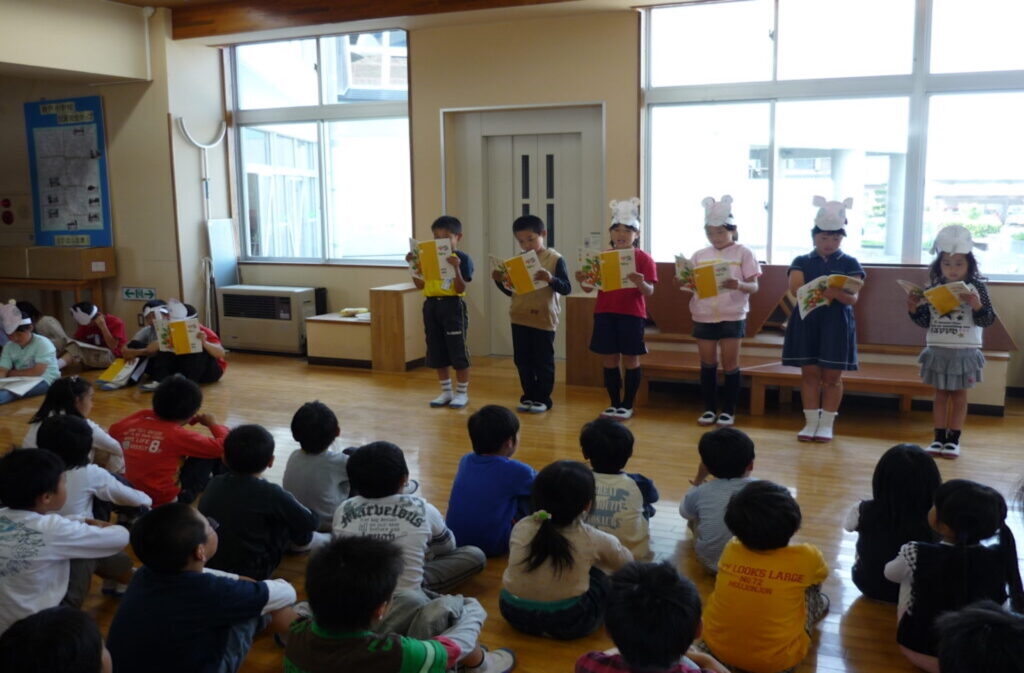
Finally, from a teacher’s perspective, I’d like to talk about the school’s daily life. The connections with local residents were strong, and students got along well regardless of their grade. At Ukedo Elementary School, human relationships were built through daily life.
The girls inherited the traditional rice-planting dance, and local residents served as instructors for udon-making classes. There were so many opportunities for the community and school to connect, and the culture of the whole community raising the children was wonderful.
Many of the parents were involved in the fishing industry and, in a sense, were very energetic people. With fathers often out at sea, mothers would be the ones hitting fly balls for softball or baseball practice. I think the sight of mothers taking the lead in looking after sports was something unique to this area.
Furthermore, the connections between teachers and students within the school were also deep.
Since all students from all grades and all staff members ate lunch side-by-side in the lunchroom, we spent time interacting in the same space every day. It was a vital space and time where the entire school connected as one.
There were also reading aloud presentations in the multi-purpose hall. Studying with younger students and showing them how older students behave—and the younger ones learning by watching them—those cross-grade connections were part of what made Ukedo Elementary so interesting.
That is likely why the older children, without being instructed by anyone, naturally walked in a way that protected and surrounded the younger ones.
Profile

Mr. Shinichi Sato
A teacher from Namie Town. At the time of the disaster, he served as the head of academic affairs at Ukedo Elementary School. After the disaster, he worked at an elementary school in Fukushima City.
In 2019, he participated as a representative of the staff at the time in the proposal to preserve the school as a disaster ruin. He hopes it will be a place where people who left the Ukedo area can reunite after a long time.
He currently works at Namie Sosei Elementary School. During long breaks, he visits Ukedo Elementary to help with on-site operations.